February 15, 2018

Edzna


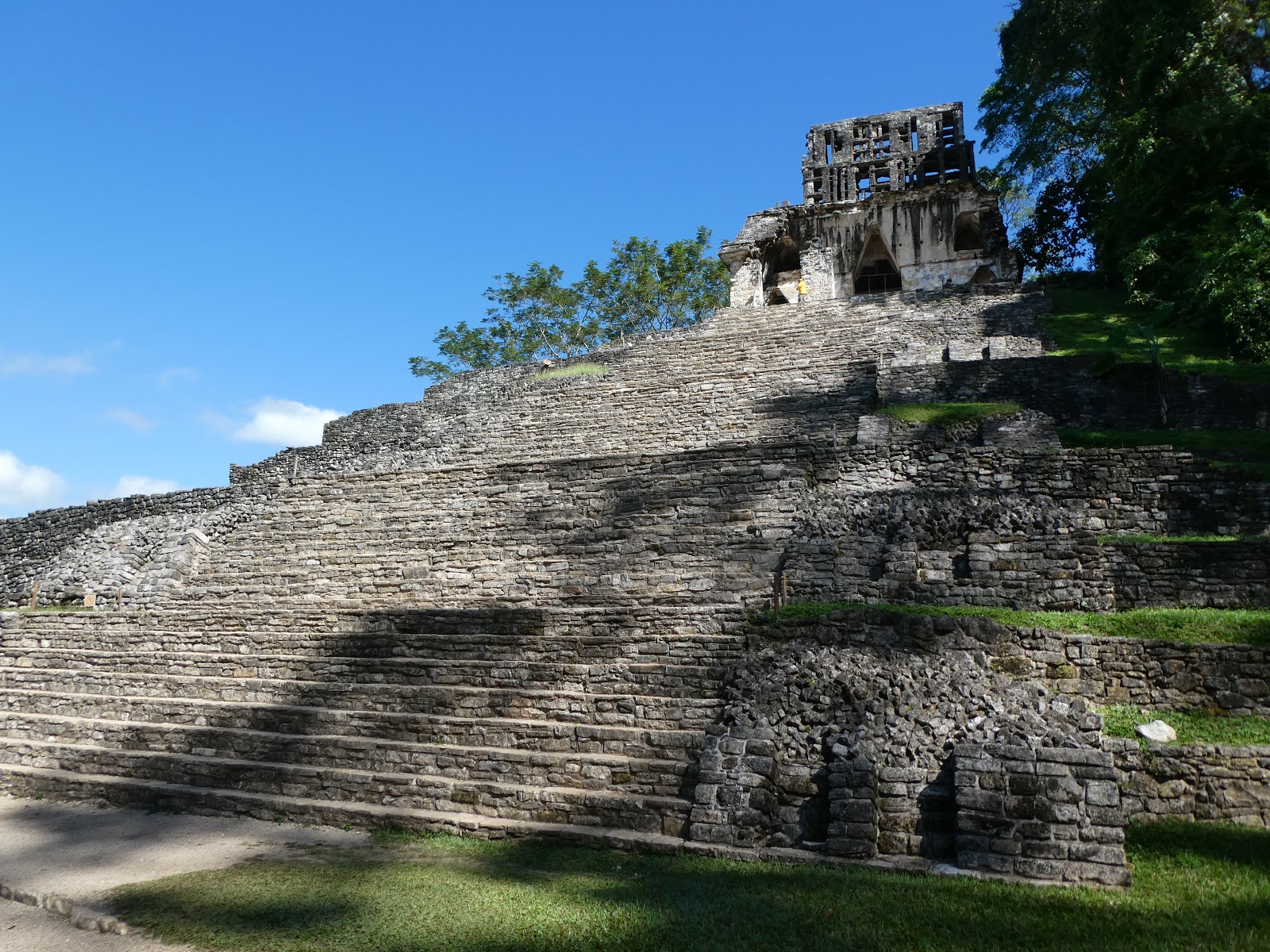
The morning after leaving the lovely Palenque and our short break from traveling, we headed to the Mayan site of Edzna.  I had never heard of this place before, and we all were in for a pleasant surprise. 

This site consists of structures made of limestone blocks.  Everything seemed to be glowing white, especially against the backdrop of the bright green of the lawns and the forest, and the bright blue sky.  Here, there were several courtyards of various sizes with buildings or other structures on all 4 sides aligned with the cardinal directions.  The largest courtyard was a raised affair with an imposing pyramidal structure on one side, and an altar in the center. 
This site had been abandoned by around 1000 AD, so no one was here when the Spanish arrived. 

An interesting piece of information about this site is that the people who lived there were the first in the area to invent cisterns for the storage of water.  These were located under the floors of the buildings. Even though we were in a very green area, they had to develop this technology to survive, since I am assuming that any rain that fell was quickly absorbed into the limestone bedrock. 

There were very few people here, and the energy was so sublime, I felt that this was a place where one could linger for a few days.  Because of that, it was much easier to gather the information on this site.  Here is what I got.  The general energy here was very soft, sweet, childlike and innocent.  Also very serene and relaxing.  This place did not seem to have any dramatic ups and downs in its history, just an even flow through time and then the sudden drop off when it was abandoned. 

The energy of water was very prominent.  Frog and rainbow showed up.  For whatever reason, I had the feeling that the plaza with the large building on one end was occasionally flooded for ceremonies so as to mirror the heavens.  The priest would stand on the center altar and call in the forces of nature, probably the rain deities. 
On the day we were there, because of the angle of the sun, the edges of some of the buildings looked like lightning bolts leading right down into the big courtyard. 
If one could see and interpret all of the friezes, this water theme might be prominent.  
After visiting this amazing site, we were off to the lovely seaside city of Campeche for an overnight stay. 

February 14, 2018

Palenque


Today is Valentine’s Day, and I have the honor of writing about one of my favorite places, Palenque.  I was with a group that stayed in that area for about a week in 2010, and just loved it.  I do believe that I had a past life there, and was curious to be able to delve into that energy again. 

After overnighting in Villahermosa, we got to Palenque around mid day, and spent the afternoon touring the site.  It is not as large as some other Mayan sites, but is just as impressive. 


The main feature is the Temple of the Inscriptions.  This is where K’inich Janaab’ Pakal, or Lord Pakal’s sarcophagus was discovered in 1952.  He ruled for 68 years.  His is an amazing story that you can easily research. 

Also, when his burial was uncovered, his body with the jade mask and jade adornments was taken to the Museum of Anthropology in Mexico City.  I had heard that in the recent past, his body was re-interred in his crypt at Palenque.  The goodies remain in Mexico City for safekeeping.  The sarcophagus, for obvious reasons, could not be removed from the Temple.
Below is the reproduction of the mask that is in the Palenque museum.
I did not track the whole site, but I did take a closer look at these stones that were lined up on one side of the Palace.  Clearly megalithic in shape and arrangement.  This is what the stones told me.  They were discovered somewhere in the nearby surrounding jungle, and hauled to Palenque.  This took quite a bit of effort to do.  The site where they were found was a small wilderness out post that served as a beacon for an off planet race that was just visiting for a short time.  It had been abandoned for several thousands of years.   They were added to the bottom of the palace as a display, and not as a part of the foundation. 


One afternoon was clearly not enough time to delve deeply into this site, and luckily, we had the next day free.  With all of the bus traveling, we all needed that!  Maxine and I chose to go back to Palenque the next day while many in our group relaxed at our hotel.  Since the next day was a Monday, there were very few people there, and it was pure delight to visit again. 

My focus on the second day was to connect with Lord Pakal.  It has been quite a few years since people were allowed to climb to the top of the Temple of the Inscriptions, so one has to satisfy themselves with standing at the base.  There is also a round stone altar in front of the steps, but I am not sure if that was its original position.  Probably not.
Lord Pakal’s sarcophagus is located in a chamber in the center of the pyramid, behind the outside staircase near ground level. 
So I stood in front of the altar and the stairway, settled in, and asked to connect with Lord Pakal.  Fairly rapidly, his spirit appeared.  He welcomed me warmly as one of his soul lineage.  “Welcome sister” was what he said.  He then expanded into a stargate and allowed me to go through out into the cosmos to the stars beyond.  It looked like I was seeing the Pleiades, but I very well could have been going into the spaces between the parts of the atoms, too.   Inner or outer, it is all the same!  I expanded my energy into the stargate and just rested there a bit.   

Upon coming out I encountered Pakal once again and we touched forehead to forehead in a final greeting.  It was my impression that I was alive here during his reign.  I was a female child that was about 10 years old when he died at age 80.  We would still have conversations long after he died.  I probably sat on those very steps! 

After walking around to visit spots that we had not seen the day before, Maxine and I went up to the back side of a building and sat on a bench looking out at the jungle. 

Then back to the hotel for a dip in the pool.  Lovely! 

February 13, 2018

Comalcalco


On January 20th, our group visited the very unique Mayan site of Comalcalco, which is located in the state of Tabasco, not far from the Gulf of Mexico.  It is unique because it is the only site where the buildings were constructed of handmade bricks instead of the usual carved limestone blocks. 

The mortar was made of ground up calcified seashells, and stucco was used to create all of the decorations.
The original structures were constructed of hard packed dirt covered with lime, some of which can still be seen. 


I have to say that the brick walls were very geometrically pleasing to the eye.   

At ground level, some of the structures even had an undulating appearance.
So this is what I tracked there.  I immediately felt a sense of a lot of activity!  This was a very busy place.  It’s as if the building and repairing of the structures went on constantly.  I can imagine that at least in the early years, the compacted earth covered with lime needed a lot of upkeep.  Consider the making of all of those thousands of bricks.  That must have been more labor intensive than quarrying limestone.  The feeling of low grade exhaustion was all around.  I am not sure I could call the workers slaves, but they may have been treated as such. 

I sensed very little connection between the elite and the commoners, and the ceremonies that they participated in had an almost mechanical and perfunctory energy.  I certainly did not feel the warm connection to the forces of nature that I felt at La Venta. 

February 12, 2018

Olmec Monoliths


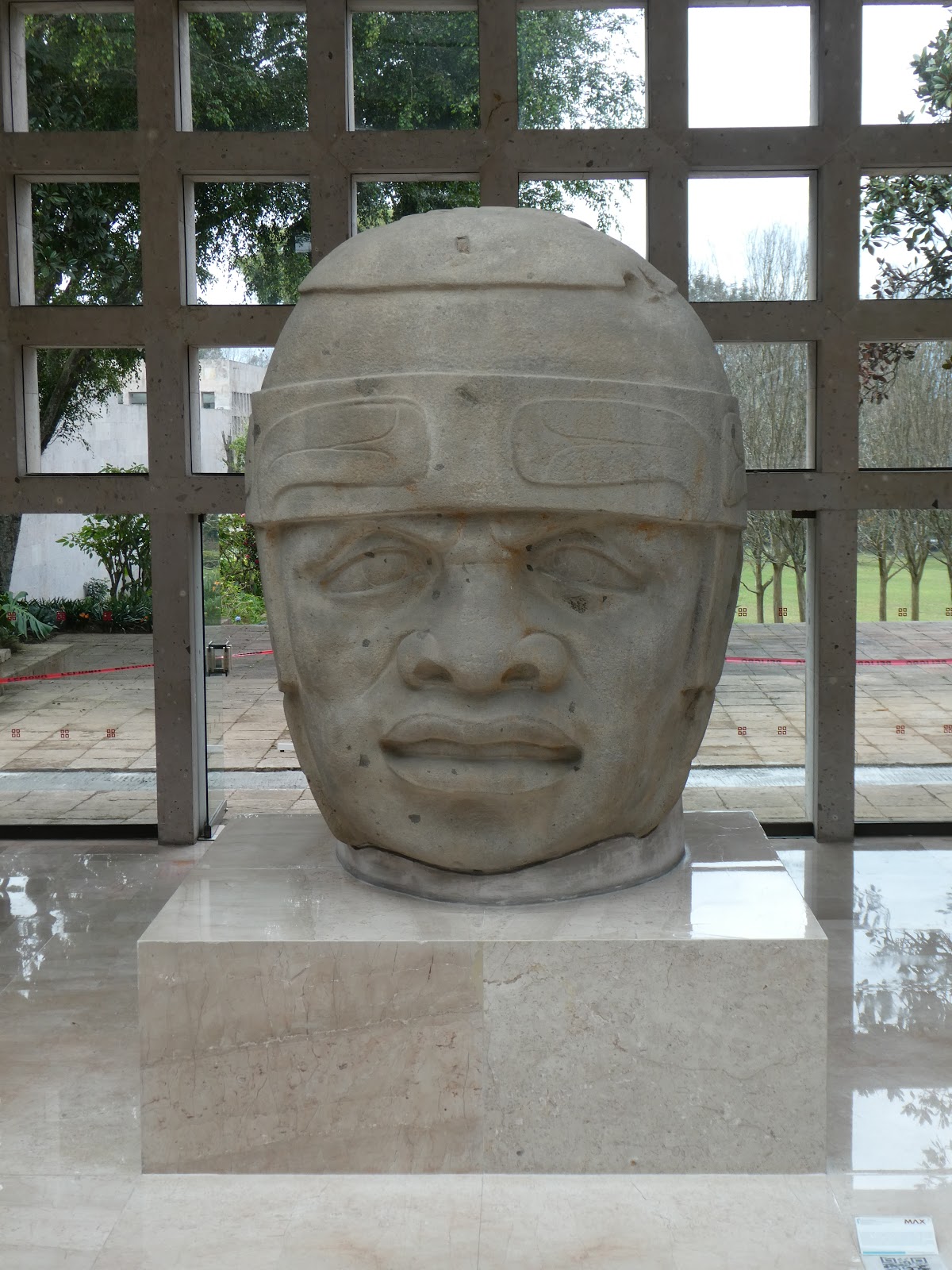
We visited 2 very nice and very different museums that featured the Olmec artifacts that had been excavated from multiple sites.  The first was the Museum of Anthropology in Xalapa.  Below are some of the colossal basalt heads, other basalt statues, and some very nice jade carvings. It is believed that the 17 heads that have been found are of specific individuals, since no 2 are alike! 

 
Below are some of the great Olmec works from the La Venta site.  They are displayed in their original form at the La Venta Park in Villahermosa.  This is an outdoor museum with a small zoo and winding pathways leading one past the fabulous artifacts.