November 13, 2023

Machu Picchu

Machu Picchu is an archaeological site northwest of Cusco and on the edge of the Amazon rain forest.  Whereas Cusco sits at 11,300’, Machu Picchu is about 3,000’ lower, warmer and more humid.  It was discovered by Hiram Bingham in 1911.  Excavation and reconstruction began shortly after that.  Here is a link that gives details about Machu Picchu.

Our group spent a few hours there the afternoon after we arrived in Aguas Calientes, and a few hours the next morning.  I had been there a few times, the latest in 2015, but things were quite different this time.  Previously, one rode from Aguas Calientes on the bus up to the site, and purchased an entry ticket there.  Then one was free to wander around at will and take time to look at everything.  Now, all of the tickets must be purchased in town ahead of time.  One is restricted to a 2 ½ hour visit and must use one of 4 pre determined routes around the site.  Most of the stairways that I previously used are roped off.  I had also planned on hiking up to the Sun Gate, which is where the hikers on the Inca Trail enter above Machu Picchu, but that route is now not available to people who want to go up.  It is one way down only. 

Nevertheless, I felt like I was coming home as soon as I got there.  Everything was so familiar.  The weather was lovely with just a bit of rain, and everything was green.  The rainy season had just started. 


Mark Carlotto’s research indicated that the central part of the site at the Temple of the Three Windows was aligned with the Bering Sea North Pole of about 130,000 years ago, and the terraces were aligned with the Hudson Bay North Pole of 20,000 to 60,000 years ago. 

Clearly this site predates the Incas by many thousands of years.  So many styles of architecture are evident there that it may be impossible to determine who built what and when. 

The central part of the site is a white granite outcropping.  The Intihuatana, the Hitching Post to the Sun, was carved out of this granite.   It was used during the Winter Solstice ceremonies all over Peru.  This is the only one that the Spanish did not destroy because they never made it to Machu Picchu! 

Other monoliths in the central sacred area were also carved from this granite.


Here is a chinchilla resting in a crack.  Cute!
This is my final shot of Machu Picchu.


November 11, 2023

Megaliths

I am crazy for megaliths.  So what are they?  A megalith is a large stone that has been used to construct a prehistoric structure or monument, either alone or together with other stones.  Here is an excellent article from Wikipedia on megaliths all around the world.  I have seen many, and they always fascinate me because of the mystery of their age and how they were moved and arranged.  On this trip we visited several megalithic sites, including Ollantaytambo, Sacsayhuaman and Machu Picchu, which I will address in another post.  

I have also come to believe that some of  the very fine megalithic structures in Peru were constructed by a pre Inca society and the Incas just appropriated these sites.   The methods of moving these multi ton stones, carving them and putting them together had been lost by the time the Incas arrived.  I also think that these sites are much older than it is said that they are.  You can reference a book by Mark Carlotto entitled “Before Atlantis, New Evidence of a Previous Technological Civilization” for his research on this. 

According to Carlotto, the Temple of the Sun at Ollantaytambo in Peru was constructed to be in alignment with where the North Pole was about 130,000 years ago in the Bering Sea.  Most of the site was constructed using local stone, but the actual temple consists of 6 megaliths weighing over 100 tons each.  The pink granite was quarried from a nearby mountain top and brought down that mountain, over a valley and up to where they were placed.   


There are also many other pink granite megaliths on the ground there.  No one knows how these stones were transported, carved and then placed. The Temple of the Sun appears to be either unfinished or partially destroyed by some disaster.


Here are some of the intricately carved and placed stones in the walls leading up to the temple. I just love them!


Moving on, Sacsayhuaman is a site above the city of Cusco.  
These megaliths were carved out of local limestone, and some of them weigh upwards to 200 tons.  It is assumed that this site was built by the Incas as a fortress. However, there was probably a preexisting structure there when the Incas arrived. 


This is a photo of the largest monolith at the site.  Many tons!  How did they move it?  It was moved from a quarry 22 miles away.
Here is our group photo while we were there to show the size and construction of the stone walls. 
Even the streets of Cusco are lined with carefully carved and fitted stones.  Some are Inca and some are pre Inca. 

This wall is inside a restaurant in Cusco.  Luckily these walls were not torn down by the Spanish.

Here is the famous 12 cornered stone, found near the Cusco Cathedral..  How did they do that? 
On our final morning in Cusco, I wandered around taking some last minute photos, and captured these snakes and a spiral.  Who carved them, I do not know. 


November 10, 2023

Dogs and Cats and Pigs

There is quite a different situation regarding dogs and cats in Peru and I suspect in most Central and South American countries.  First of all, very few cats were to be seen on this trip, and I think that the few that we saw were feral.  Maybe we didn’t see more of them because they were mostly out at night.  I am a sucker for cats since I have one of my own.  The kitten at the top of this post looks a lot like the cat I have at home.  I wanted to scoop her up and take her back with me!

This one was huddled on the sidewalk outside out hotel in Chiclayo.

About half way through the trip, while still in the Northern coastal area, we ate lunch at an out of the way open air restaurant. 

Hanging around were a mother cat and 4 almost grown kittens.  2 calicos and 2 tabbies.  The staff of the restaurant would shoo them away routinely.  I do not know what they ate, but we took the opportunity to drop morsels of food down to them when no one was looking.  They would eat anything, as opposed to cats in the Western world that can be quite picky.  I even reached down to scratch the mother cat on her head, and she meowed at me in response.


Dogs were another matter altogether.  They roamed the streets at will, but we were told that they were not strays, even though very few had collars.   All of them looked well cared for, groomed and well fed.  After one of the ladies I was walking around Aguas Calientes with gave a nice looking German shepherd a scratch on the head, he followed us back to our hotel, only to be chased away by the security guard.  Most dogs however, did not welcome human contact or being touched.  If you had food, that was probably another matter. 

Here are dogs at the parking lot to Chan Chan.  The one on the hill was clearly the top dog of the pack.


These hairless dogs were being kept and bred on the grounds of the National Museum of Sipan.

This chunky beagle was patrolling the village square in Pisac.
It was not unusual to find a dog napping right on the sidewalk.  One had to be careful not to step on them.

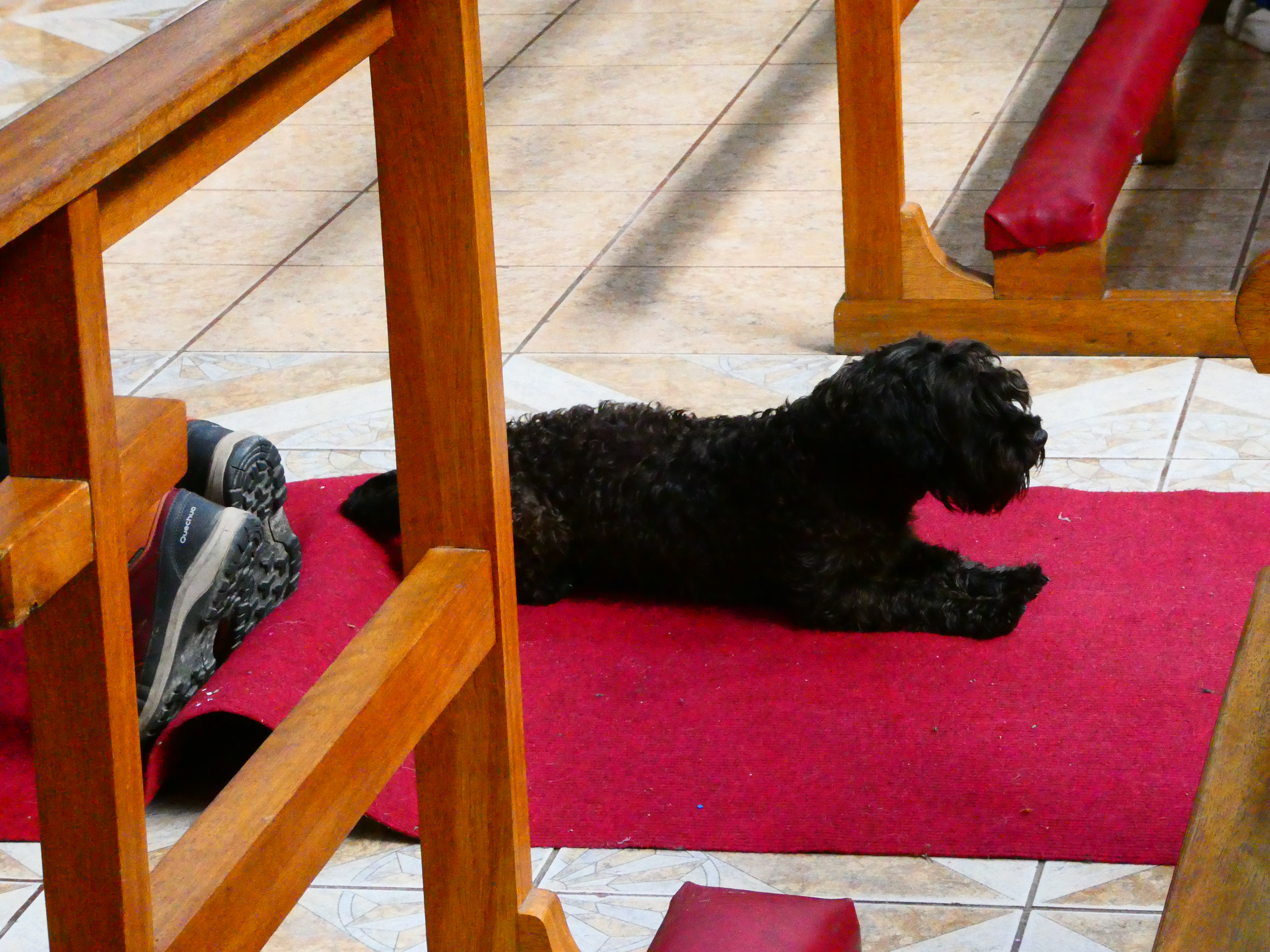
This cutie was hanging out inside the local church in Aguas Calientes. 
So here is the scoop.  Most people who own dogs let them out in the morning so that they can roam and play with their friends.  They have quite a life of their own.  It is assumed that they return home at night or when they are hungry.  A lot of them hang around where their owner works—a shop or restaurant.   In Cusco, we saw a few with coats on.  In Lima, we were staying in the nicer part of town, and we saw numerous dog walkers out with multiple dogs each. 

I remember years ago when we were camping out at Raqchi in Peru when the village dogs started to hang around.  They all looked to be on the scrawny side.  Then the top dog in charge arrived.  He was medium size, well fed, black and had a spiked collar on.  Clearly he was there to “boss” the rest of the dogs.

And of course there are the guinea pigs.  They are not pets, but are eaten on special occasions.  Most households raise them. Here we were visiting a traditional household in Ollantaytambo.

Here is our guide Diana who caught one.  You could tell that she was happy to have made her catch.
There are a few restaurants near Pisac that advertise guinea pig meals.  For the tourists no doubt. This is how they advertise outside their restaurants.
Interesting that if you search the internet for guinea pig, you get the pet.  If you search for cuy, the Quechua word for them, you get meat.  I prefer neither!