December 9, 2019

A Day of Archaeology, Part 2

This is the continuation of the previous post, “A day of Archaeology, Part 1”.  After lunch that day, we proceeded to Mitla, which means the “place of the dead”.  This was the religious center for the Zapotecs, whereas Monte Alban was considered to be the political center.  Our guide, Robert, said that the “pope” lived at Mitla!  The Zapotecs believed that this site held the gateway between the world of the living and the world of the dead.  It was very busy when we were there, probably because of the “Day of the Dead” celebrations that were going on at the same time. 

We first visited a section of the ruins that had a catholic church built adjacent to it.
The unique feature of Mitla is the fretwork made of small pieces of polished stone that were fitted together into geometric designs without using mortar.   No other Mesoamerican site has this.  This fretwork covers lintels, tombs, and is generally everywhere one looks. 

The other aspect that was very fascinating to me and probably not noticed by anyone else was the megalithic aspect of the many lintels above the doorways.  From the back side, these huge stones were rough hewn and eroded and covered with lichens.  On the front side that faced the courtyards however, these stones were very finely cut and pristine looking.  Quite a difference from back to front. 


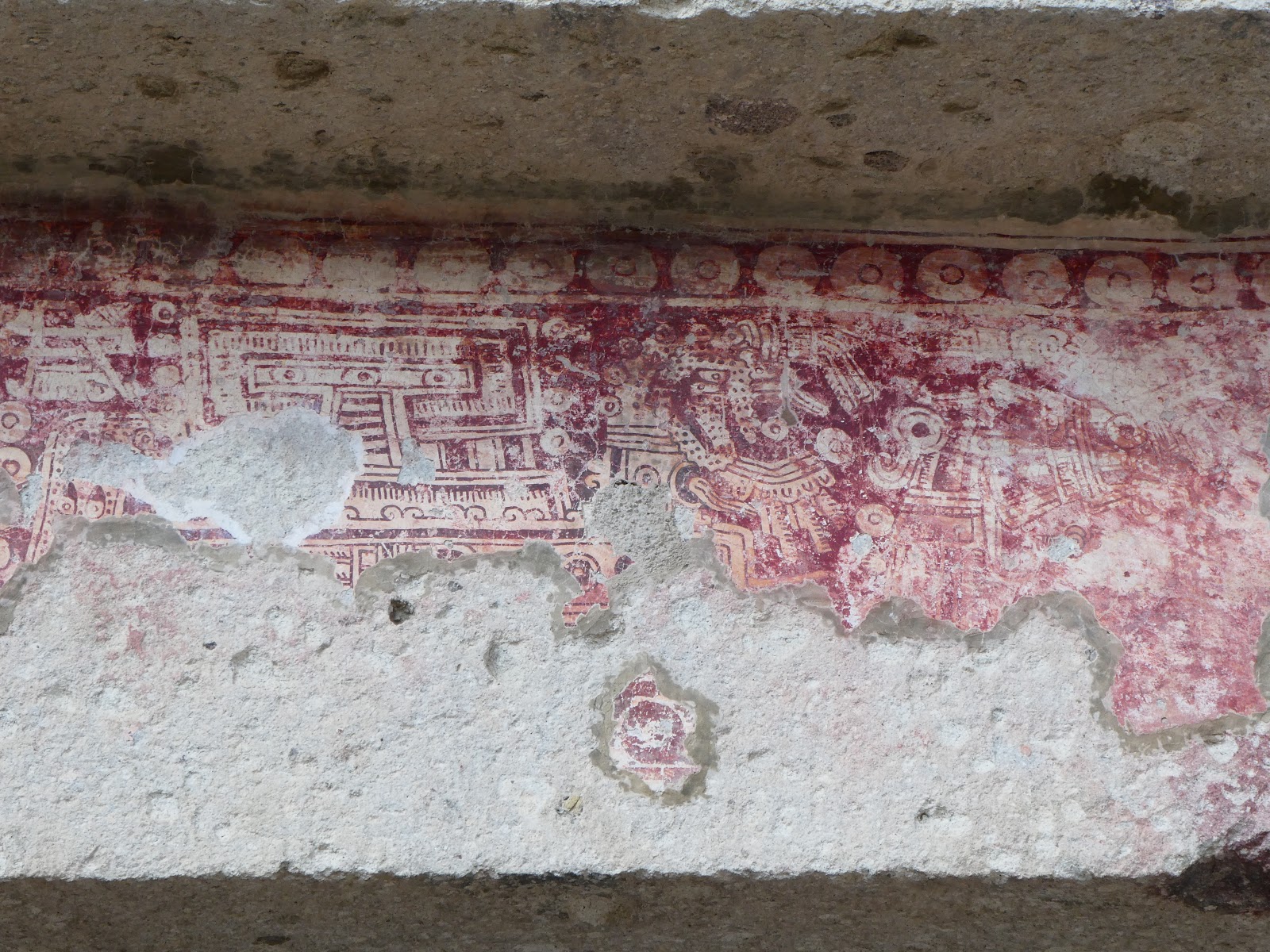
Many of these were also plastered and painted with red designs. 
When I asked our guide about how they were able to cut the stones so precisely, he said that they sawed back and forth with a string, and poured sand into the cut to act as a grinding agent.  Well, that may be true for the straight cuts, but what about the stepped areas, as below?
There were also some repurposed megalithic stones used in the outer wall of the church.
 
We then walked a short distance to the other and larger part of Mitla.  What an impressive sight this was, with the red outer walls, and fretwork everywhere. 

I did pay close attention to similar areas where there were flat, stepped and finely cut panels, but in this location, they appeared to be assembled with small sections, and not carved out of one huge monolith. Also note the finely fitted stones without the use of mortar below.
Upon exiting this part of Mitla, I was thrilled to find a monolith propped up in the outer courtyard.  Note the rough and natural surface in contrast to the “sliced” and decorated underside.  Clearly all cut out of one solid piece of rock.  Unfortunately, the temple just behind it had not been restored, and was not open to the public.  I would have loved to do some exploring there! 
The last strip of the day was a site named Yagul.  What a delight!  The sun was starting to go down, and thunder storms were threatening, so this was a quick visit.  All that is left there are the restored foundations covered with plaster, but you can tell that the buildings here were huge.  This was also a place where one could find a secluded spot and sit in meditation for a bit.


We were also able to go down into a triple tomb that had 3 burial chambers.  Of course, the contents are long gone. 


The rain held off until we got back on our bus.  What a lovely and action packed day!  

December 7, 2019

A Day of Archaeology, Part !

The previous day our group visited several of the local villages where a variety of craft items were being produced.  These included black pottery, woven goods, and some very expensive hand carved and painted wooden animals. The one at the top of the page was priced at around $10,000!  We were also privileged to visit the in-town hacienda of the famous Mexican artist Rudolfo Morales.  He died in 2002, and we were allowed to go into his bedroom/studio which had not been changed since the day he died. 

Now, we were packing 4 very interesting archaeological sites into one day.  That was not hard to do since they were not too far apart.   One interesting feature of some of the sites was that there was an underground tomb right in the middle of the living space.  Most likely, the king or ruler and his female consort were buried there, and worshiped as deities.  I did not find this kind of feature in all of the other Mayan sites that I have visited in the past.  In addition, all of the sites we looked at here had at least one ball court.

The first site of the day was Dainzu, which was a Zapotec city founded in 350 BC.  It sits at the foot of a large hill.  The community buildings and the ball court were at the bottom, the palace a bit higher up slope, and the sacred areas continued on up to the top of the hill.  Our guide had helped excavate this site in the past, and told us that all of the rock art and altars were located further up the hill.  I would have loved to go up there, but we didn’t have enough time, and the trails were steep and dangerous. 
 Ball court.


Next, we traveled to Lambityeco.  This site had a totally different feel to it.  The property itself was quite extensive, but only the main building had been excavated.  Here, we also saw the extensive use of stucco, which has a tendency to melt away over time.   

Note the unique use of pottery shards in the mortar of the wall. This is unique to this site.
Because of our guide’s connection with the caretakers here, we were allowed to go into the center of the palace to see the friezes and the entrance to the tombs. 


Of course, all of these tombs had been excavated in the past, so there was no creepy energy left from the burials.  I will continue with this day of archaeology in the next post. 

December 5, 2019

Monte Alban

One of the advertised highlights of the trip was a visit to the ancient site of Monte Alban, where we went on our second day.  It is located on a high hill in the middle of the Oaxaca Valley, and was occupied by the Mixtecs and the Zapotecs between 500 BC and 850 AD.   It was also heavily influenced by the Teotihuacan culture which was north of this area. 

This is a massive site with large buildings and a lot of open space.  Right away I noticed the stark contrast between the highly decorated Mayan ruins I visited 2 years ago versus the mostly plain facades here.  Below are some photos.


 When our group got to Monte Alban, and since this was an archaeological tour, our resident archaeologist proceeded to give us a lecture.  I only stayed through part of it, since I was itching to get around the site.  My mission, as usual, was to find the high energy sacred places there.  It didn’t take long.  I got the biggest hit at the altar in the center of a sunken plaza.  I took out my small crystal skull to get imprinted with that energy. 

Building J was the other place here that fascinated me.  It was clearly built with archeoastronomy alignments in mind, but to date, no one has been able to figure out what they were exactly.  It's oddly angled walls and fortress like structure is unique in all of Mesoamerica. 
Here is what remains of a doorway that hints of something megalithic.  
That afternoon, we took a walking tour of the area around the hotel.   The architecture is fabulous, and there are many old churches and haciendas that have been converted into small hotels, museums and galleries.  Hidden treasures were around every corner.